
EV Charging
Can Your Electrical Panel Handle a Level 2 EV Charger?
By Sky’s Electrical Contracting · Sep 25, 2026
Short answer
Maybe. Whether your electrical panel can support a Level 2 EV charger depends on the panel, service size, existing electrical loads, available capacity, and the charger being installed. Some Columbus-area homes can add an EV charger without upgrading the electrical service, while others may need panel or service changes first.
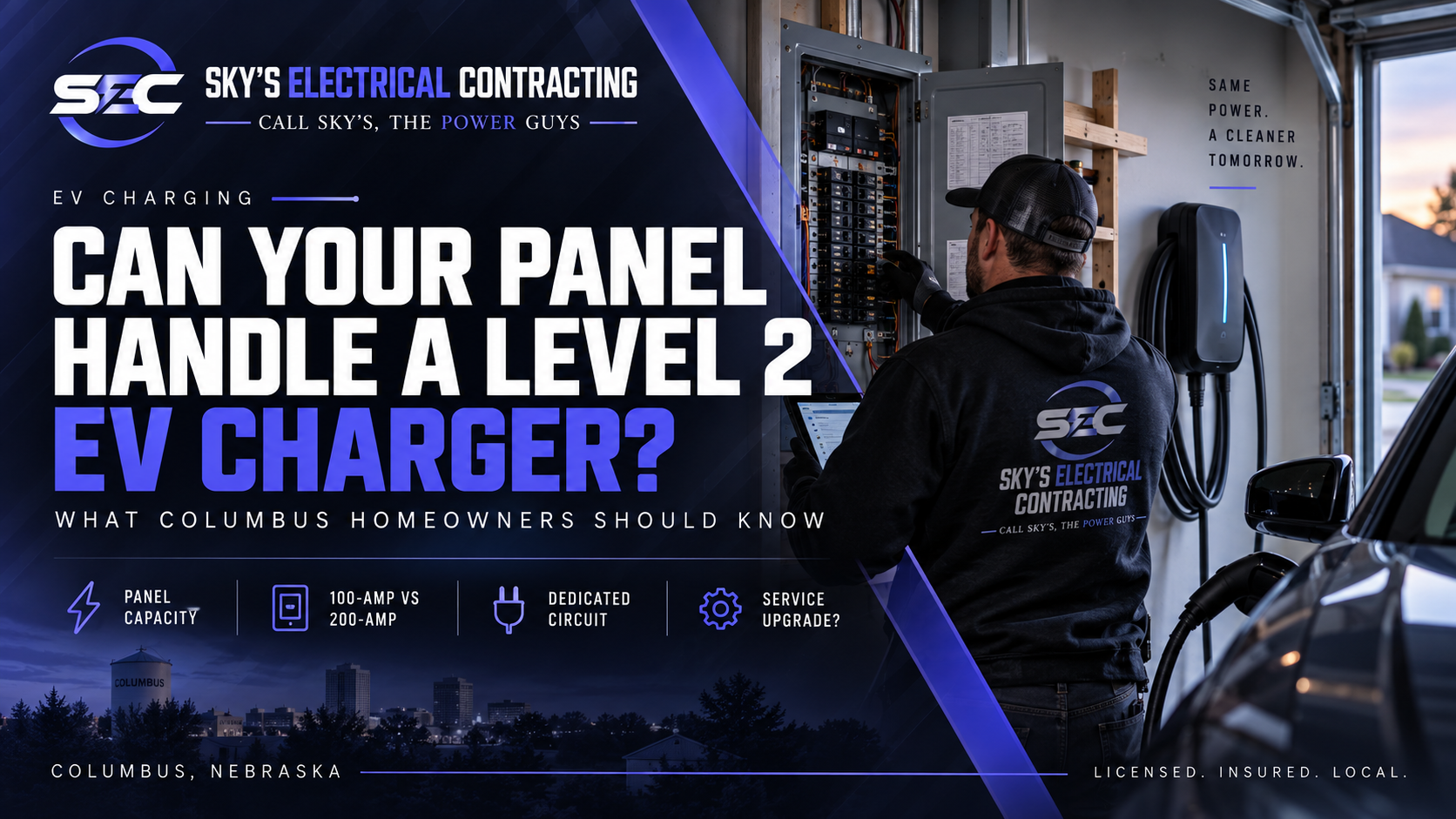
Can Every Home Handle a Level 2 EV Charger?
Not automatically.
Before installing a Level 2 EV charger, the existing electrical panel and service should be evaluated to determine whether the home has enough available electrical capacity for the added load.
Tim Sky, owner of Sky’s Electrical Contracting in Columbus, Nebraska, says the first thing he looks at is the type of electrical panel already installed in the home.
He also considers the size of the electrical service and the larger electrical loads already being used in the house.
That means the answer is not simply:
“You have a 100-amp panel, so you need an upgrade.”
Some homes may have enough available capacity.
Others may need electrical changes before the charger is installed.
Learn more about EV charger installation in Columbus.
What Does an Electrician Check Before Installing an EV Charger?
An EV charger adds another significant electrical load to the home.
Before installing the charging circuit, Tim looks at several parts of the existing electrical system.
Those may include:
- Electrical panel type
- Existing service size
- Available panel space
- Existing electrical demand
- Electric HVAC equipment
- Electric cooking equipment
- Other large appliances
- Charger requirements
- Distance from the panel to the charger
- Where the charger will be installed
The goal is to understand how the charger fits into the electrical system that is already there.
Does a 100-Amp Service Automatically Need to Be Upgraded?
No.
Tim says many homes around Columbus and the surrounding area were originally built with 100-amp electrical services.
That does not automatically mean an EV charger cannot be installed.
The important question is how much electrical demand is already being placed on that service.
For example, a home with several large electric loads may have less available capacity than a home with fewer high-demand electrical systems.
Tim specifically considers electrical equipment such as:
- Electric HVAC systems
- Electric ranges
- Other major electrical loads
When several of those loads are already present, a service upgrade may become more relevant.
But the existing electrical system should be evaluated before making that decision.
Learn more about electrical panel upgrades.
Do You Need a 200-Amp Service for a Level 2 EV Charger?
Not necessarily.
A 200-amp service provides more available electrical capacity, but service size by itself does not answer whether an EV charger can be installed.
Tim says that homes with larger existing electric loads may benefit from the additional capacity of a 200-amp service.
The correct recommendation depends on:
- Current electrical demand
- Existing service size
- Panel condition
- Charger requirements
- Other electrical equipment
- Future electrical plans
The best approach is to evaluate the home rather than automatically assuming that every EV charger installation requires a service upgrade.
What Types of Electrical Panels Can Be a Concern?
The existing panel itself is another important part of the evaluation.
Tim specifically mentioned several older panel types that can create concerns when homeowners are planning to add an EV charger.
Those include:
- Screw-in fuse panels
- Pushmatic panels
- Federal Pacific / FPE panels
Older equipment does not automatically mean the homeowner should make changes without an evaluation.
But if the panel is outdated, failing, or not appropriate for the additional electrical load, other electrical work may need to happen before the charger is installed.
Does an EV Charger Need a Dedicated Circuit?
Level 2 home charging equipment typically requires a dedicated electrical circuit designed for the charging equipment being installed.
The exact circuit requirements depend on the equipment.
The electrician needs to consider:
- Charger specifications
- Circuit requirements
- Breaker requirements
- Wiring requirements
- Panel capacity
- Installation method
This is one reason the charger model and electrical system should be reviewed before installation begins.
Learn about dedicated circuits and remodel electrical work.
Hardwired vs. Plug-In EV Chargers
Home EV charging installations can generally be either hardwired or connected through an appropriate dedicated receptacle, depending on the equipment and installation.
Tim says this choice can affect the electrical work involved.
Hardwired EV Charger
A hardwired charger connects directly to the electrical circuit.
The installation depends on the charger requirements, circuit design, wiring route, and location.
Plug-In EV Charger
Some chargers use a dedicated receptacle.
That still requires a properly designed circuit for the charging equipment.
Neither option should be treated as universally better for every home.
The appropriate installation depends on the charger, the electrical system, and where the equipment will be installed.
What Affects the Cost of EV Charger Installation?
Tim says the cost of a home EV charger installation can vary based on the electrical work required.
Factors can include:
- Distance between the panel and charger
- Charger location
- Existing panel capacity
- Wiring route
- Hardwired vs. plug-in installation
- Circuit requirements
- Breaker requirements
- Whether panel or service changes are needed
Tim discussed a rough installation range of approximately $800 to $1,700 for the types of home EV charger projects he has worked with.
That is not a guaranteed quote.
The actual price depends on the specific home and installation.
Does an EV Charger Mean You Need a New Electrical Panel?
No.
Installing an EV charger and replacing an electrical panel are two separate decisions.
The panel only needs to be changed if the existing equipment, available capacity, condition, or project requirements make that necessary.
Some homes may be able to install the charging circuit without replacing the panel.
Others may need:
- Panel modifications
- A panel replacement
- A larger electrical service
- Other electrical changes
The existing electrical system needs to be evaluated first.
What If You Are Already Planning Other Electrical Upgrades?
An EV charger may not be the only new electrical load you are planning.
You may also be considering:
- Electric HVAC equipment
- Kitchen appliances
- A garage workshop
- A hot tub
- Basement finishing
- A home addition
- Other electrical upgrades
If several new electrical loads are being added, it may make sense to look at the home’s electrical capacity as a whole instead of planning each project separately.
That can help determine whether the existing panel and service still fit the home’s future electrical needs.
Can an EV Charger Be Installed in a Garage?
Often, yes.
The actual installation depends on the garage, charger location, and existing electrical system.
An electrician may consider:
- Attached vs. detached garage
- Distance from the electrical panel
- Wiring route
- Existing garage electrical
- Charger location
- Where the vehicle will normally park
- Equipment specifications
Longer or more complicated wiring routes can also affect installation cost.
How Sky’s Approaches an EV Charger Installation
Sky’s Electrical Contracting starts by looking at the electrical system that is already in the home.
The process generally includes:
1. Review the Charger
Tim looks at the charger or charging setup the homeowner plans to use.
2. Evaluate the Existing Electrical Panel
The panel and electrical service are reviewed to determine whether there is enough available capacity.
3. Review the Installation Location
Tim considers where the charger will be installed and how the electrical circuit can reach that location.
4. Determine the Electrical Work Required
The circuit and installation are planned around the equipment and existing electrical system.
5. Complete the Installation
Sky’s completes the electrical work based on the agreed scope.
EV Charger Installation in Columbus, Nebraska
Sky’s Electrical Contracting provides Level 2 home EV charger electrical installation in Columbus, Nebraska and the surrounding area.
Tim Sky grew up in Columbus and began working in the electrical trade in 2012.
His career includes substantial commercial and industrial electrical experience, which gives him a strong background in electrical systems and load considerations.
At the time of his recent interview, Tim had completed two EV charger installations and was working on a third.
His first question before adding the charger is simple:
Can the electrical system that is already in the home support the new load?
If you are planning a home EV charger, Sky’s can evaluate the existing electrical system and explain what the installation requires.
Request EV charger installation from Sky’s Electrical Contracting.
Related Resources
- 7 Signs You May Need an Electrical Panel Upgrade in Columbus, Nebraska
Not every older electrical panel needs to be replaced. Learn seven signs that your panel may need attention, what Tim Sky looks for in Columbus-area homes, and when a panel or service upgrade may make sense.
- Why Does My Breaker Keep Tripping? Common Causes and When to Call an Electrician
A breaker that keeps tripping is usually reacting to a problem somewhere on the circuit. Learn common causes Tim Sky sees, why a larger breaker is not the answer, and when Columbus homeowners should have the issue checked.
Frequently Asked Questions
Need an Electrician in Columbus?
Call 402-710-9587 or send a service request and Sky's will get back to you.