
Electrical Safety & Code
Do You Need an Electrical Permit in Columbus, Nebraska? What Homeowners Should Know
By Tim Sky | Sky’s Electrical Contracting · Sep 25, 2026
Short answer
Yes, many electrical projects in Columbus, Nebraska may require a permit and inspection, depending on the work being completed. The City of Columbus directs electrical permit and inspection matters to the Nebraska State Electrical Division. Projects involving electrical panels, service changes, new circuits, EV chargers, and larger electrical alterations are examples where permitting requirements should be confirmed before work begins.
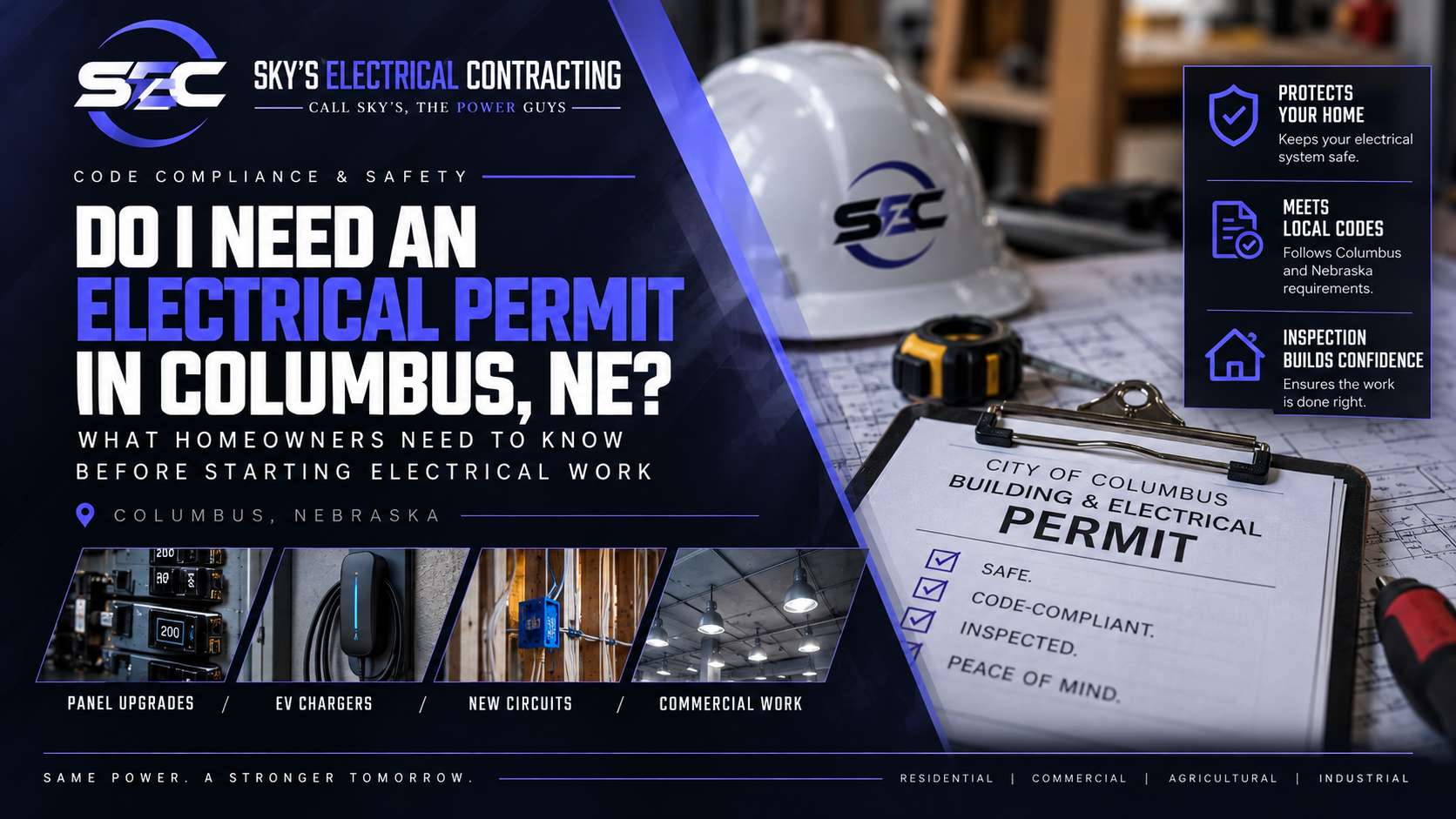
Do Electrical Projects in Columbus Need a Permit?
Some do.
Whether an electrical project requires a permit depends on the type and scope of the work being completed.
For homeowners in Columbus, Nebraska, electrical permitting and inspections are not handled the same way as every other type of building permit.
The City of Columbus directs electrical permit and inspection matters to the Nebraska State Electrical Division.
That means one of the first steps before starting a larger electrical project is determining what permitting and inspection requirements apply to the work.
Sky’s Electrical Contracting can help homeowners understand what applies to their specific project before electrical work begins.
Who Handles Electrical Permits in Columbus, Nebraska?
The City of Columbus directs electrical permits and inspections to the Nebraska State Electrical Division.
The Nebraska State Electrical Division oversees electrical licensing, permitting, and inspections where it has jurisdiction.
The state also provides an electrical inspection jurisdiction map that allows a property address to be searched to determine:
- Which electrical inspection jurisdiction applies
- Which inspection district the property falls into
- Contact information for the applicable inspection authority
This is useful because electrical inspection jurisdiction can vary by location throughout Nebraska.
For a Columbus homeowner in Platte County, it is better to confirm the jurisdiction for the actual property rather than assume every Nebraska electrical project follows an identical process.
What Electrical Projects May Need a Permit?
Permit requirements depend on the project, but larger electrical changes are the types of projects where homeowners should expect permitting to become part of the conversation.
Examples can include:
- Electrical panel replacements
- Electrical service upgrades
- Changes from 100-amp to 200-amp service
- New electrical circuits
- Level 2 EV charger circuits
- Larger remodel electrical projects
- Additions
- New electrical equipment
- Service equipment changes
- Other substantial electrical alterations
This does not mean every electrical repair automatically requires a permit.
A small repair and a full electrical service upgrade are very different projects.
The safest approach is to determine what applies before the work begins.
Learn about electrical panel upgrades in Columbus.
Do Electrical Panel Upgrades Need Permits or Inspections?
Panel replacements and service upgrades are the types of electrical projects where permitting and inspection requirements commonly become relevant.
Tim Sky, owner of Sky’s Electrical Contracting, says inspection is an important part of properly completed panel work.
For example, changing a home from a 100-amp electrical service to a 200-amp service involves more than simply replacing the indoor panel.
Depending on the project, the work may involve:
- Electrical panel
- Breakers
- Service conductors
- Meter equipment
- Service entrance equipment
- Utility coordination
- Other electrical components
Because the scope can be substantial, permitting and inspection should be addressed before the project begins.
Learn more about electrical panel replacements and service upgrades.
Does an EV Charger Installation Need an Electrical Permit?
A Level 2 EV charger installation can involve a new dedicated electrical circuit and a significant new electrical load.
That makes permitting and inspection another consideration when planning the installation.
Before installing a charger, Tim looks at:
- Existing electrical panel
- Service capacity
- Available panel space
- Charger requirements
- Existing electrical demand
- Circuit requirements
- Charger location
- Wiring route
Whether the project requires additional panel or service work depends on the existing electrical system.
Permit requirements should also be confirmed for the specific property and installation.
Learn more about Level 2 EV charger installation.
What About New Circuits During a Remodel?
Remodeling can involve anything from a small electrical change to several new circuits and major alterations to the home.
Projects such as:
- Kitchen remodels
- Basement finishes
- Garages
- Workshops
- Home additions
- New appliances
- New 240V equipment
may involve electrical work that should be reviewed for applicable permit and inspection requirements.
Tim recommends considering the electrical work early in the remodel rather than waiting until walls and finishes are complete.
That gives the homeowner and electrician time to evaluate the existing panel, existing wiring, new loads, and project requirements before the electrical work becomes harder to access.
Learn about dedicated circuits and remodel electrical work.
What Happens After an Electrical Permit Is Pulled?
The exact process depends on the project and applicable jurisdiction, but permitted electrical work generally moves through several stages.
1. Determine the Scope of Work
The electrician evaluates the existing electrical system and determines what needs to be installed, replaced, or modified.
2. Confirm Permit Requirements
The applicable electrical permitting requirements are identified before the work begins.
3. Complete the Electrical Work
The electrical work is completed based on the project scope and applicable electrical requirements.
4. Request Inspection When Required
If the project requires inspection, the completed electrical work is reviewed by the applicable electrical inspection authority.
5. Address Corrections if Necessary
If an inspector identifies something that needs to be corrected, that work is addressed before final approval.
The purpose of the process is to verify that permitted electrical work has been installed in accordance with the applicable requirements.
What If an Electrical Inspector Finds a Problem?
An inspection correction does not necessarily mean the entire electrical system is bad.
It means the inspector identified something within the inspected work that needs to be addressed.
Depending on the issue, a correction may involve:
- Circuit protection
- Grounding or bonding
- Wiring
- Electrical panel work
- Equipment installation
- GFCI or AFCI protection
- Another part of the permitted electrical work
After the correction is completed, reinspection may be required before the project receives final approval.
Learn more about electrical code corrections.
Does an Older Home Have to Be Completely Updated to Current Electrical Code?
Not automatically.
Electrical codes change over time.
An older home does not necessarily have to be completely rewired every time electrical standards change.
What needs to be updated can depend on:
- The work being performed
- The existing condition
- What portions of the system are being modified
- The applicable electrical requirements
- Inspection findings
- The scope of a remodel or addition
That distinction matters.
The goal should be to understand what the current project actually requires rather than assuming every older part of the home needs to be replaced.
Which Electrical Code Does Nebraska Use?
Nebraska generally uses the 2023 National Electrical Code as the minimum standard for electrical wiring, subject to Nebraska-specific laws, amendments, and exceptions.
Permits submitted to the Nebraska State Electrical Division on or after August 1, 2024 are generally reviewed under the 2023 NEC requirements adopted by Nebraska.
That does not mean every sentence of the national code should be interpreted without considering Nebraska-specific rules.
For a homeowner, the more useful question is:
What requirements apply to this specific project and property?
That is something the electrician and applicable inspection authority can determine before work begins.
Can a Homeowner Do Their Own Electrical Work in Nebraska?
Nebraska law contains provisions allowing a residential property owner to perform certain electrical wiring on the owner’s principal residence without holding an electrical license.
That does not mean permits, inspections, or electrical requirements automatically disappear.
It also does not extend broadly to every property type.
Rental properties, another person’s home, and other situations can be treated differently.
Because electrical work can affect both personal safety and property safety, homeowners should understand the permit and inspection requirements before beginning electrical work themselves.
Do not treat this article as a substitute for guidance from the applicable electrical inspection authority.
Why Permits and Inspections Matter
For most homeowners, permitting can feel like another administrative step in the project.
But electrical inspection serves an important purpose.
Electrical systems can contain problems that are not obvious after walls are closed or equipment is energized.
Inspection creates another review point for permitted electrical work.
It can also provide documentation showing that applicable electrical work went through the required process.
For projects such as:
- Panel upgrades
- Service upgrades
- EV chargers
- Remodel electrical
- New circuits
- Larger electrical additions
it is better to understand those requirements before the project starts.
Who Pulls the Electrical Permit?
The answer depends on the project and circumstances.
When Sky’s Electrical Contracting is completing electrical work that requires permitting, Tim can explain how the permitting and inspection process applies to that project.
Homeowners should not assume they need to figure out the entire process before contacting an electrician.
Start with the project.
From there, the applicable permit and inspection requirements can be identified.
Electrical Permits and Inspections in Columbus, Nebraska
Sky’s Electrical Contracting serves homeowners and businesses throughout Columbus, Nebraska and surrounding communities. Learn more about our electrical services in Columbus, Nebraska.
Tim Sky grew up in Columbus and began working in the electrical trade in 2012.
His career includes years of commercial and industrial electrical experience before starting Sky’s Electrical Contracting.
Today, Tim works directly with customers on electrical troubleshooting, panel work, EV chargers, dedicated circuits, remodel electrical, code corrections, and commercial electrical projects.
If you are planning electrical work in Columbus and are not sure whether the project requires a permit or inspection, you do not need to solve that question before calling.
Tell Sky’s what you are planning, and Sky’s can help determine what electrical work and permitting considerations apply to the project.
Request electrical service from Sky’s Electrical Contracting.
Related Resources
- 7 Signs You May Need an Electrical Panel Upgrade in Columbus, Nebraska
Not every older electrical panel needs to be replaced. Learn seven signs that your panel may need attention, what Tim Sky looks for in Columbus-area homes, and when a panel or service upgrade may make sense.
- Why Does My Breaker Keep Tripping? Common Causes and When to Call an Electrician
A breaker that keeps tripping is usually reacting to a problem somewhere on the circuit. Learn common causes Tim Sky sees, why a larger breaker is not the answer, and when Columbus homeowners should have the issue checked.
- Can Your Electrical Panel Handle a Level 2 EV Charger?
Before installing a Level 2 EV charger, your electrical panel and service should be evaluated to see whether they can support the added load. Learn what Tim Sky looks at in Columbus-area homes, when a panel upgrade may be needed, and what affects EV charger installation.
Frequently Asked Questions
Need an Electrician in Columbus?
Call 402-710-9587 or send a service request and Sky's will get back to you.